
Why Parent-Supported Home Practice Matters in Articulation Therapy
If your child's SLP has asked you to practice at home, that practice is more than an optional extra. Here is how parent-supported home practice can reinforce articulation therapy, support carryover, and realistically fit into everyday family routines.
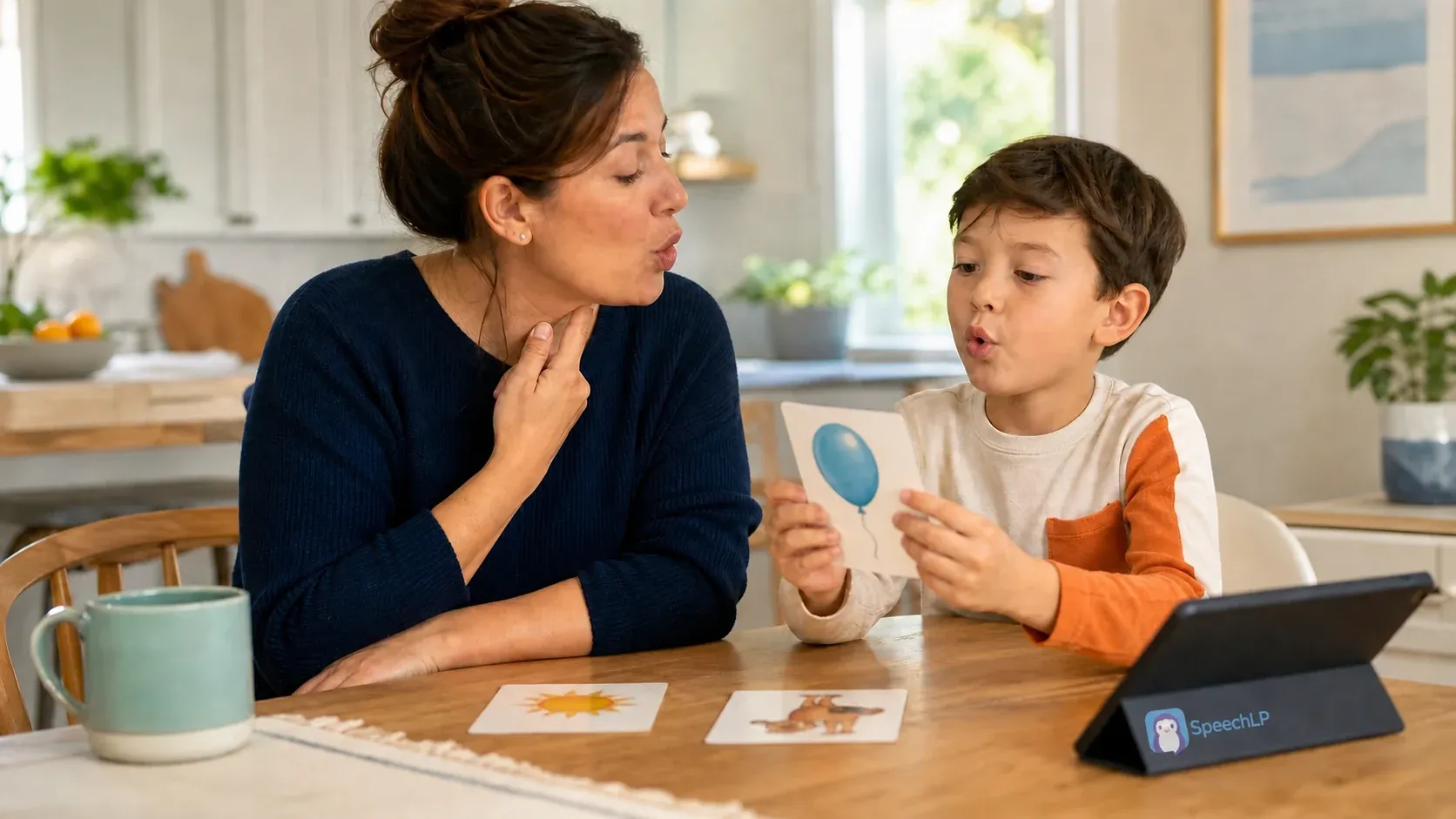
If your child is working with a speech-language pathologist (SLP) on sounds such as /r/, /s/, or /l/, you have probably been asked to practice at home. That practice is more than an optional extra: when it is selected and coached by an SLP, it can give a child more opportunities to use a new speech skill between sessions.
Research suggests that parent-supported practice can be helpful, but it is not a one-size-fits-all solution. The activity, frequency, and level of support should match the child's goals and stage of treatment.
Why Practice Between Sessions Matters
Children may see an SLP once or several times a week, depending on their needs and setting. The American Speech-Language-Hearing Association (ASHA) identifies treatment dosage and format as service-delivery variables that may affect outcomes. Dosage includes how much practice a child receives and how often it occurs.
Home practice can add carefully planned opportunities between appointments, but it does not replace skilled assessment or treatment. In a small 2020 study, five children with moderate-to-severe phonological impairment received one weekly session with an SLP plus two parent-led home sessions. After training, parents delivered the program competently, and all five children improved on treated words. Generalization to untreated words varied, however, showing why results from one small study should not be treated as a guarantee for every child.
Home Practice Can Support Carryover
A child may learn to produce a sound during a structured activity before using it consistently in everyday conversation. This transfer is often called generalization or carryover.
Parents can provide practice opportunities during familiar routines, such as reading, getting ready for school, or riding in the car. These moments may help a child use a target sound beyond the therapy setting. The right activity depends on the child's current level: practicing a sound in isolation is different from practicing it in words, sentences, or conversation. Your SLP should guide that progression.
Training and Support Matter
Simply sending home a worksheet is not always enough. A 2025 scoping review of parent-led home programs for children with speech sound disorders found that the evidence is still emerging. It also identified several factors that may support participation and success, including a clear explanation of the activity, specific instructions, opportunities to observe the technique, feedback from the SLP, and a plan that fits the family's routines.
Ask your SLP to demonstrate what to do, watch you try it, and explain how to respond to both correct and incorrect attempts. Ongoing check-ins help ensure that practice remains accurate and appropriate as your child progresses.
Busy Weeks Are Normal
Time pressure, competing responsibilities, and stress can make home practice difficult. In one preliminary study of 17 families of children with cleft or craniofacial conditions, 88% reported at least one psychosocial barrier, and 59% completed less than 75% of assigned practice. Because the sample was small and specialized, those figures should not be assumed to represent every family, but they illustrate that barriers are common and worth discussing.
If practice is regularly difficult to complete, tell your SLP. A shorter or simpler plan may be more useful than an ambitious plan that does not fit your week.
What Effective Home Practice Can Look Like
- Keep it brief and manageable. Short practice periods are often easier to fit into family life. Follow your SLP's recommendations for frequency and number of attempts.
- Ask for a demonstration. Watch the technique, then practice it with your SLP before trying it independently.
- Use familiar routines. When appropriate, include target words in activities your child already enjoys instead of creating another task.
- Keep the experience positive. Praise effort and successful attempts. Avoid correcting every conversational error unless your SLP specifically recommends it.
- Maintain a feedback loop. Tell your SLP what is working, what feels difficult, and whether your child is becoming frustrated or avoiding practice.
Missing an occasional day does not mean the plan has failed. A realistic routine followed over time is more useful than aiming for perfection.
The Bottom Line
Articulation therapy is a partnership. The SLP provides clinical expertise, chooses appropriate targets, teaches the technique, and monitors progress. Parents can provide additional, everyday opportunities to practice. Current evidence suggests that, with suitable training and support, parent-led practice can reinforce treatment and support carryover for some children. It does not guarantee faster progress, and the same plan will not suit every child.
SpeechLP is designed to make brief articulation practice more engaging and easier to include in daily routines while complementing, not replacing, guidance from a licensed SLP.
References and Further Reading
- American Speech-Language-Hearing Association. (n.d.). Speech Sound Disorders: Articulation and Phonology [Practice Portal].
- Pritchard, K., Murray, E., et al. (2025). Parent-led home-based intervention for children with speech sound disorders: A scoping review. International Journal of Language & Communication Disorders.
- Sugden, E., Baker, E., Munro, N., Williams, A. L., & Trivette, C. M. (2020). Evaluation of parent- and speech-language pathologist-delivered multiple oppositions intervention for children with phonological impairment. American Journal of Speech-Language Pathology, 29(1), 192–208.
- Torres, E., Solis, R. N., Zhang, L., & Grames, L. M. (2024). Psychosocial barriers to completion of speech home exercise programs. Perspectives of the ASHA Special Interest Groups, 9(3), 743–753.
This article provides general educational information and is not a substitute for an individualized evaluation or treatment plan from a licensed speech-language pathologist.
Keep Practicing with SpeechLP
Keep momentum between sessions with guided articulation and language practice in the app.